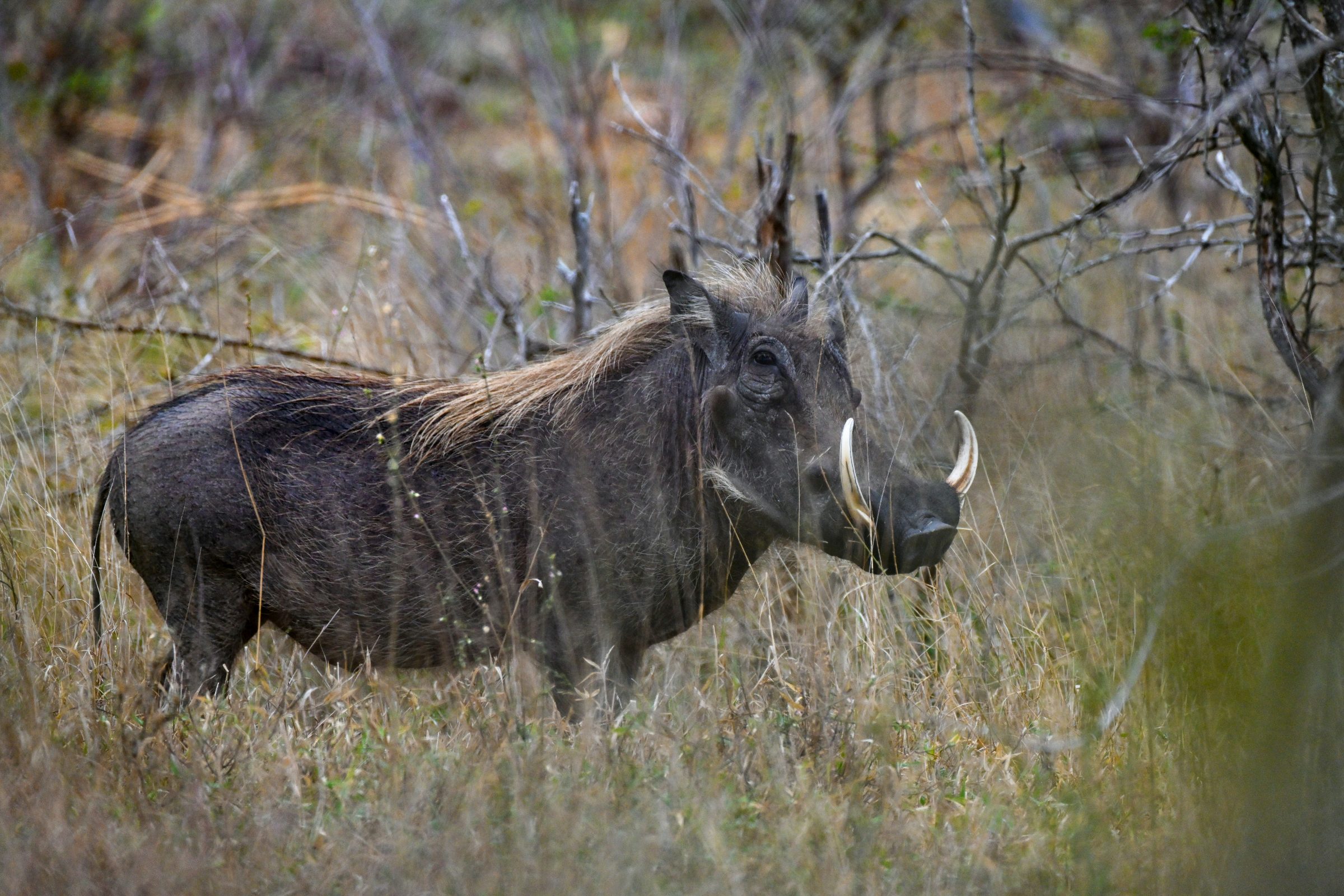
The warthog is a true underdog of the African wilderness. Born without the speed of the gazelle or the strength of the buffalo, it relies instead on a set of surprising and clever survival strategies.
One of its most unusual features the short, stubby neck is no design flaw. In fact, it’s perfectly adapted for the warthog’s feeding habits. As a grazier and root digger, the warthog spends most of its time close to the ground. Its neck allows it to kneel comfortably on calloused, padded "knees" (actually the wrists of its front legs), lowering its head for long periods while foraging on short grasses and bulbs. This unique posture conserves energy and gives it access to food sources that other grazers might overlook.
Even in danger, the warthog’s intelligence and instincts shine. When spooked by predators, it dashes for its burrow but it doesn't just run in headfirst. Instead, it enters backward, tail high like a little flag. Why? So it can charge out face first if the threat follows. It’s not just about escape it’s about readiness. The raised tail, stiff and upright, may even serve as a beacon for young ones to follow through tall grass.
Another secret to the warthog’s survival is its resourcefulness. It rarely digs its own burrows but takes over abandoned aardvark holes or termite mounds, reshaping them into cozy, safe shelters. These dens become vital during the dry season or when raising piglets.
Warthogs are also surprisingly social. They form small family groups, or sounders, led by a dominant female. Within these groups, they share grooming duties and work together to detect threats strength in numbers, guided by vigilance.
So next time you see a warthog with its head to the ground and tail to the sky, don't laugh too quickly. You're witnessing a master of adaptation. A survivor not through strength, but through quiet, humble genius.